For the body to remain healthy, it needs to make a certain type of proteins. And a very complex machinery is involved during this process. These complex processes are not fully understood. Hence research is ongoing in this area of science.
Some of the raw chemicals that make up these proteins is stored in your DNA, but some others are brought in from outside through the consumption of food.
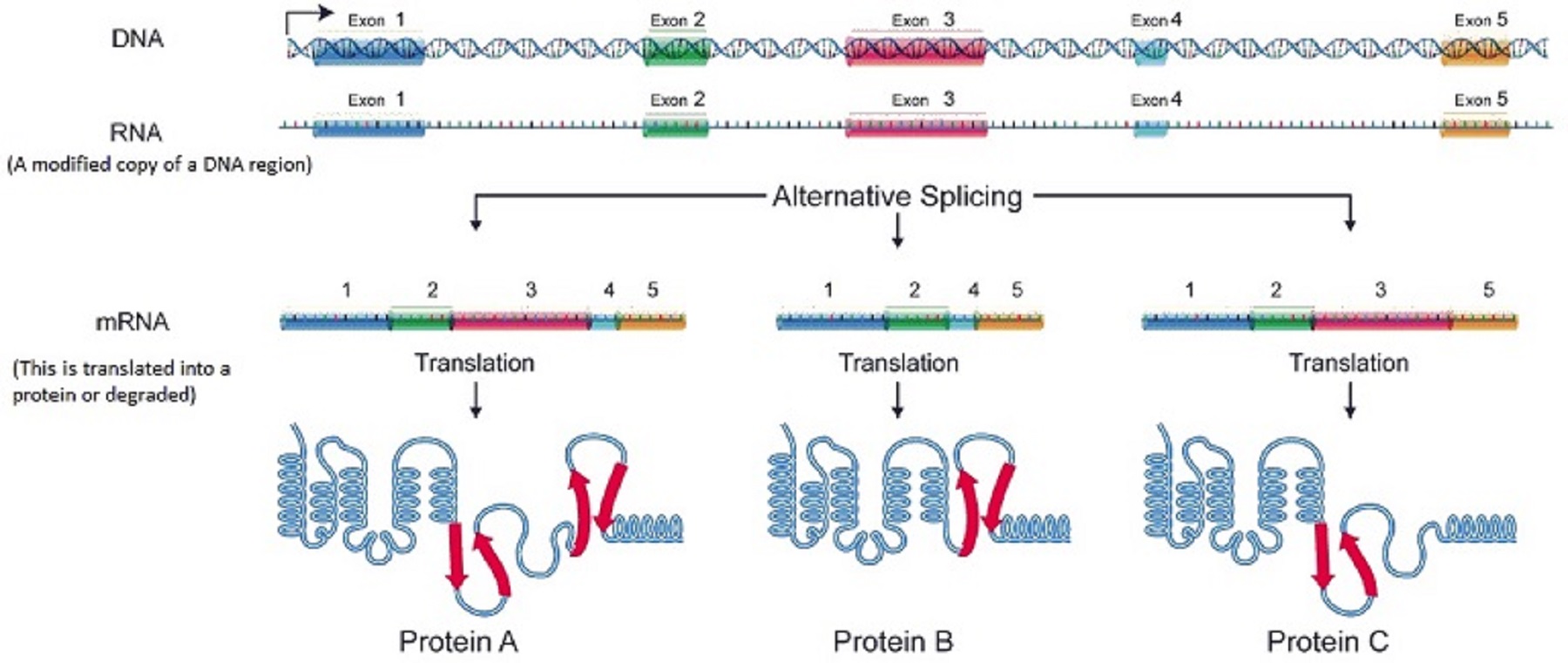
This DNA, raw chemicals that will eventually become a protein, is first copied then modified in a multitude of ways. Again research is ongoing and we do not know the depth of it all. Having said that, one of the known modifications is the splicing of the initial chemical copies. Through this process, some parts are kept and fused together while other parts are degraded and recycled. Yes, recycled. In other words, the cell strives for zero waste.
If you think the cell designed itself, then maybe you need to think again. For it would take longer than the life of this universe for all the chemical reactions to take place in a reasonable time frame in just one cell! Yes, just one cell. But there are billions of cells in your body! And you are not the only one in this universe. So think again!
There are five known types of splicing processes and depending on which one happens, the protein outcome will be different. As of this moment in writing, this splicing process remains unpredictable. It is not random, but it is not predictable either, for now.
The following modified figure shows a simple illustration of the splicing process. The original figure is in the Public domain, via Wikimedia Commons and it belongs to the National Human Genome Research Institute:
Now, you may be one of those fortunate people who could read Arabic, and moreover you may also be fortunate in having expertise in reciting the Quran.
I say fortunate, but a lot of it is down to your inner intention and will. You can learn it no matter who you are.
When reciting the Quran, where to start and where to stop is key in conveying its meanings. Indeed, there are five types of stops:
1. A must stop
2. An unlawful stop
3. Better to continue than to stop
4. Better to stop than to continue
5. Optional. You can stop or continue reciting.
6. There is even a ‘silent’ stop; where the utterance of the letters is briefly stopped, but you carry on afterwards without breathing in fresh air till your next stop.
And here is one simple concrete example from the Quran in its original Arabic form that may illustrate the change in meaning by choosing to stop at one word rather than another:
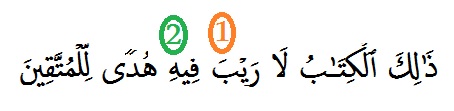
One can either choose to stop after reciting the word at position (1) or stop after reciting the word at position (2) in the above Quranic excerpt (Quran 2:2).
This was revealed when the Prophet Muhammad, peace be upon him, reached Medina. In Mecca, before Medina, he addressed a community that was made up mainly of pagans, but his address now included a large population who referred to a scripture. Some of this new audience may doubt all of this new scripture, i.e. Quran.
For this group of people, a common ground needs to be established. For some of its content is factual and there is no doubt about that to anyone. For this group of people stopping at position (1) is more suitable. While some other members may entertain the idea that some of this new scripture, i.e. Quran, is factual, but there may be doubt about the rest of it. For this group of people stopping at position (2) is more suitable.
Hence, if one stops at position (1), then the meaning of the above excerpt (Quran 2:2) may be rendered as follows:
“This is the Book about which there is no doubt. In it there is guidance for those who ward off harm.”
If one stops at position (2), then the meaning of the above excerpt (Quran 2:2) may be rendered as follows:
“This is the Book that contains no doubts at all, a total guidance for those who ward off harm.”
Historically, it has been reported that some famous references in Quran recitation, like Imam Nafii of Medina and Imam Asim of Koufa stopped at position (1), while the majority of other references stopped at position (2).
It takes a lot of dedication and learning to recite the Quran properly. For when you recite the Quran in a healthy way, you are engaging in a healthy splicing activity.
At that moment you may or may not be aware that you are in sync with a splicing process deep within your cells. And you may think of this as being close and personal, but it can reach diverse communities and far away lands. They can also be spliced for a multitude of reasons.
 Salihun